
Today, Civic News Company is publishing a new report on the local information needs of New Yorkers. Based on a poll conducted late last year, it outlines the gaps New Yorkers feel between the local information they view as important to their lives and what’s available to them each day. It also explores their specific information needs around education, and their engagement in local civic life.
You can read the new report here.
It builds on two previous reports: a national report of local information needs that you can read about here, and a first local report on the information needs of Chicagoans that you can read about here.
The report is the third Civic Information Needs Census (CINC) conducted by Civic News Company as a part of a pilot program working to establish shared, actionable insights to to support the emerging field of civic information: news organizations, libraries, schools, government agencies, individuals, and community groups coming together across the country to help people get the information they need. A changing media ecosystem, including the collapse of local American print newspapers, has contributed to meaningful challenges — including increased local government inefficiency and corruption, polarization, and civic disengagement. It has also created meaningful opportunities — including new ways to reach people and lower distribution costs.
The insights in the report are rooted in a survey of 1,428 New York City residents done by EMBOLD research, a non-partisan, non-political data science and research company. It asked respondents for their views of the importance of and their satisfaction with local topics like economic opportunity, transportation, and education. And it asked about education topics, media habits, and civic engagement.
The report has also been used to anchor two gatherings of New York City civic information providers, one in person last year and one virtual this week. Both included leaders from news organizations, libraries, universities, think tanks and government, including: The City, Documented, Epicenter NYC, WNYC, 5Boro, The Bell, The Independent Budget Office, Press Pass NYC, CUNY’s Newmark Journalism School, Brooklyn Public Library, New York Public Library, and Queens Public Library.
All of this research builds on and complements work studying information ecosystems, including the Civic Information Index, Pew’s surveys on local news, and local surveys on information needs like those done in Philadelphia. Over time, we hope that studies like these are done in ways that are consistent (allowing comparison across populations), persistent (allowing for comparison over time), and, above all, actionable (informing actions taken by the field).
The topline results of the survey it is based on are here, and the crosstabs of that survey are here. The full survey and an overview of the methodology are here.
Here are 6 takeaways you’ll find in the full report:
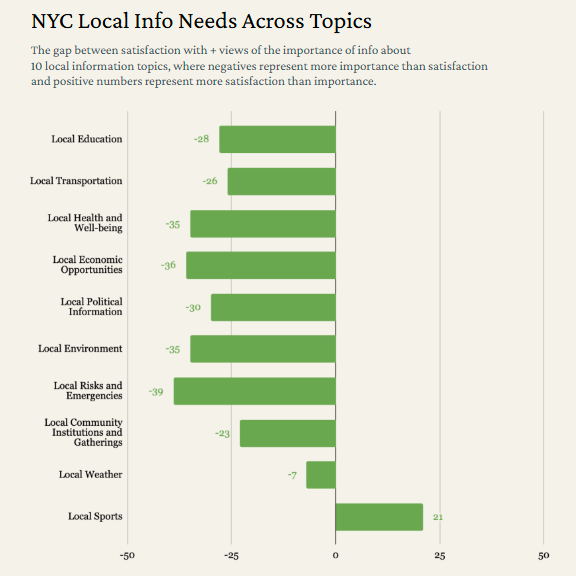
1. On the 7 topics essential for civic health, there is a 26 to 39% gap between the importance New Yorkers place in having local information and their satisfaction with what they have. (PAGE 16)
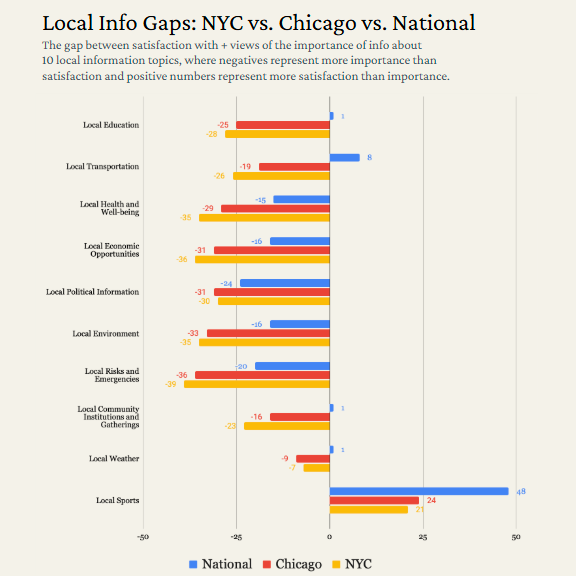
2. The gaps between information importance and satisfaction are bigger for New Yorkers than those previously surveyed with these questions, on average 4% bigger than Chicagoans and 21% larger than Americans overall. (PAGE 19)
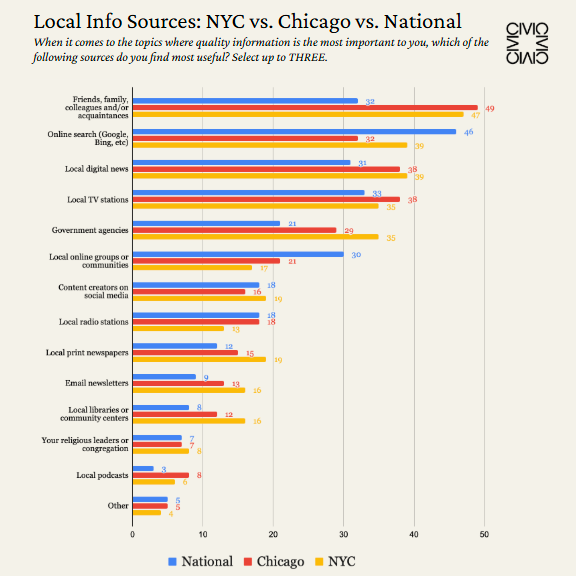
3. New Yorkers, like Chicagoans, are much more likely to turn to personal networks for quality info than Americans overall. (PAGE 21)
4. On 10 of 12 situations surveyed, 50% of New Yorkers or less were satisfied with the info they have in critical life situations like choosing where to work or live, responding to local crime, or reporting potholes or other local infrastructure issues. (PAGE 24)

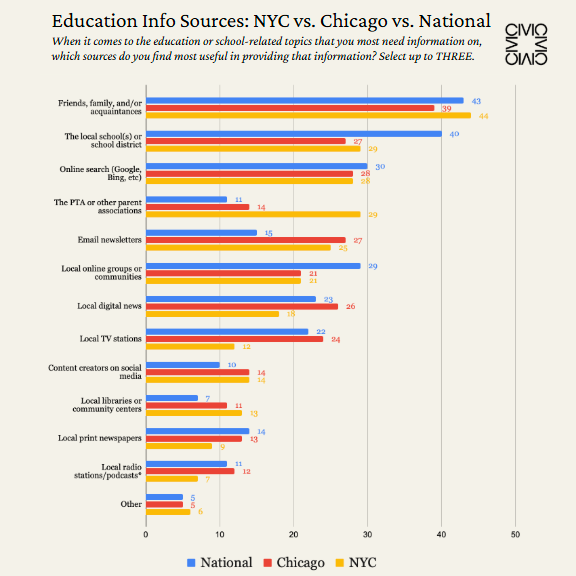
5. When it comes to education information, New Yorkers are much more likely than Chicagoans or Americans overall to turn to local parent groups and much less likely to turn to local TV. (PAGE 29)
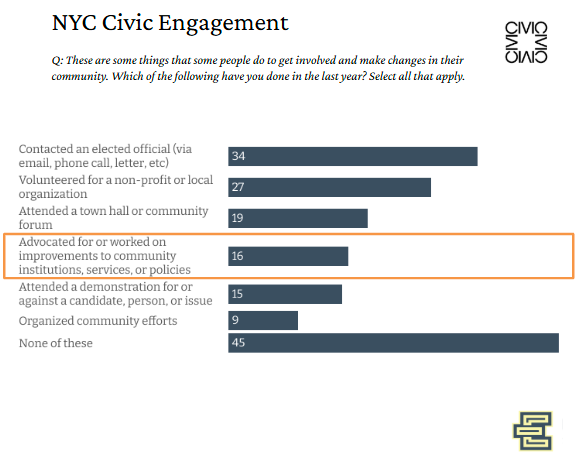
6. 16% of New Yorkers say they’ve advocated or worked on systemic change in their local community. 9% say they’ve done that on education specifically. (PAGES 33, 36)